Loading articles...
Related articles
The Houston Ship Channel handles 209,000+ barge movements per year across a system where fleeting rates run $154–$275/day, new tank barges cost $4.5 million, the national fleet lost 103 units in 2024, and dock construction takes 18–36 months. This analysis covers transit volumes, fleet supply constraints, fleeting and dock rate benchmarks, construction economics, modal cost comparisons, and the capacity consolidation reshaping the Gulf Coast barge market.
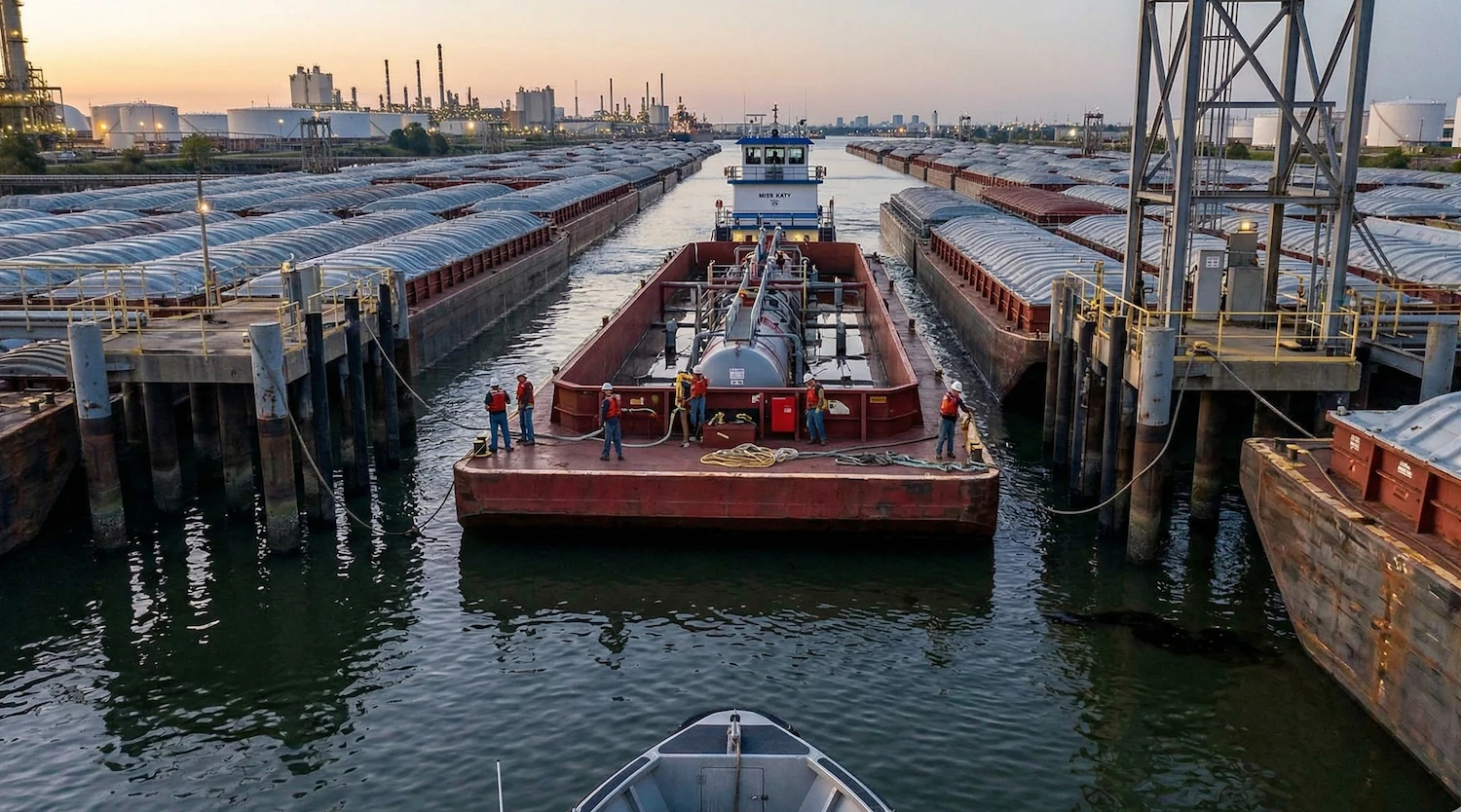
The Houston Ship Channel handles more barge traffic than any waterway in the United States — over 209,000 barge movements in 2025 alone — yet the infrastructure supporting that traffic is approaching a breaking point. Fleeting capacity is constrained, the national tank barge fleet is shrinking by roughly 100 units per year, and the cost to build a new 30,000-barrel barge has climbed to $4.5 million. For terminal operators, fleet operators, petrochemical shippers, and investors evaluating sites with barge access on the Gulf Coast, these dynamics define the market opportunity and the risk landscape through 2026 and beyond.
The Houston Ship Channel is the spine of America's largest petrochemical complex — 42% of national base petrochemical capacity and proximity to 60% of U.S. refining capacity. It ranked #1 among U.S. ports by total waterborne tonnage in 2023 at 309.5 million short tons. Barges account for roughly 90% of all vessel traffic on the channel, yet most public attention focuses on deep-draft ships. The barge ecosystem — fleeting, shifting, storage, dock access — is where the real operational bottleneck lives.
Port Houston recorded 209,616 barge movements through the Ship Channel in 2025, consistent with the long-running average of 200,000+ transits annually. That translates to roughly 635 barges per day, moved by approximately 400 tugs, operating alongside 50–60 deep-draft vessel movements daily. Total waterborne tonnage through the Ship Channel's public and private terminals reached 309.5 million short tons in 2023, with public terminals alone setting consecutive records: 53.1 million tons in 2024 and 54.5 million tons in 2025.
The commodity mix is dominated by petroleum. Approximately 70% of imports and exports through the channel are petroleum products. Key barge commodities include crude oil, refined products (gasoline, distillate, residual fuel oil), naphtha and solvents, petrochemicals, LPGs, and asphalt. The channel serves 200+ private terminals belonging to refiners, chemical manufacturers, and midstream operators between the Turning Basin and Morgan's Point.
The Gulf Intracoastal Waterway is the artery connecting Houston to the broader Gulf Coast barge network. The GIWW carried 106.4 million short tons in 2023, making it the third-busiest U.S. waterway behind only the Mississippi and Ohio Rivers. The Texas portion alone handles 70% of total GIWW traffic despite representing only one-third of its 1,300-mile length. Petroleum and chemical products account for 91% of GIWW-Texas tonnage — approximately 80 million tons annually worth an estimated $77 billion in economic activity. The GIWW's 12-foot controlling depth is purpose-built for barge transportation, connecting all 11 deep-draft Texas ports from Brownsville to Beaumont.
The U.S. inland tank barge fleet stands at approximately 3,923 barges in active revenue service (Waterways Journal IRR survey, end of 2024). By any measure, the fleet has been essentially flat since 2019 — and in 2024, it shrank. Only 36 new inland tank barges were delivered in 2024 against 139 retirements, producing a net loss of approximately 103 units. Industry sources expect 50–60 deliveries annually in 2025–2026, roughly matching retirements but not recovering the deficit.
The fleet is old and getting older. Average age of the inland tank barge fleet has climbed from approximately 15 years in 2019 to over 17 years by the end of 2024. Kirby Corporation, which operates 1,094 inland tank barges (28% of the U.S. fleet) with 24.2 million barrels of capacity, reports its own fleet averaged 17.0 years at year-end 2024. Roughly 600 tank barges nationally are 30 years old or older, with approximately 350 exceeding 40 years — candidates for near-term retirement that will further tighten supply.
New construction economics explain the stagnation. Kirby's COO stated on the Q4 2025 earnings call that a new 30,000-barrel clean product barge costs approximately $4.5 million, and that current market rates require a 40%+ increase before ordering new builds becomes economically rational. Only two major barge shipyards remain in the U.S. — Arcosa Marine Products (Madisonville, Louisiana) and Heartland Fabrication (Brownsville, Pennsylvania) — following the 2018 closure of Jeffboat, which had been the nation's largest inland shipyard. Fabricated steel plate prices rose 13% year-over-year through December 2024, and shipyard labor costs are described as running hot.
Market utilization reflects these supply constraints. Kirby reported inland barge utilization of 94% in January 2026, with spot rates running 10% above term contract rates — a signal of tight capacity. Genesis Energy, operating 82 inland barges with 2.3 million barrels of capacity, reported 93.6% inland utilization in Q1 2025 and has repeatedly characterized the market as being in the early stages of a multi-year structural shift. Kirby's inland term contract renewals carried annual escalators of 3–5%, and the company generated record revenues of $3.36 billion in 2025 with marine operating margins exceeding 20%.
A barge fleeting area functions as the rail yard of the waterway system — a permitted commercial area where tows are broken down, reassembled, and barges are staged while awaiting terminal berths, cleaning, heating, blending, or pickup by line-haul towboats. Under USCG regulations (33 CFR 101.105), a fleeting facility is defined as a commercial area, subject to permitting by the Army Corps of Engineers, for the making up, breaking down, or staging of barge tows.
At least 15–20 identifiable fleeting areas operate on the Houston Ship Channel and its tributaries, based on USCG VTS Houston-Galveston chartlets and industry mapping. Facilities range from 2-barge capacity to 300 barges, with an average of approximately 75 barges and roughly 38 barge movements per day per facility.
Published rate data from Kirby Inland Marine's February 2024 tariff provides the clearest pricing benchmark. Daily fleeting charges at Houston/Channelview run $154 per day for regulation-size barges (≤200 feet × 35 feet) and $232 per day for non-regulation barges (over 200 feet). In/out charges — the cost to move a barge into or out of fleet — add $382–$450 per movement depending on location. Oversized barges (201–300 feet) pay 1.5–2× the standard rate. At Corpus Christi, rates run higher: $176–$264 per day. Independent operators like Red Fish Barge charge up to $275 per day for barges up to 300 feet. Once berth waiting time triggers demurrage, costs jump to $400–$650+ per day — making efficient fleeting access a critical cost variable.
Major fleeting operators on the HSC include Kirby (multiple locations at Lynchburg, Old River, Channelview, and Texas City), Enterprise Marine Services, Genesis Marine, Buffalo Marine (Texas City Fleet), G&H Towing, Turn Services (20-acre La Porte fleet opened January 2022), Houston PetroChemicals (two fleeting areas, 60+ barge capacity), and AccuTRANS.
A fleeting site requires specific infrastructure: mooring dolphins (approximately one per four barges), approach channels dredged to at least -4 feet NAVD88 for empty barges (loaded barges draw 9–12 feet), a minimum channel width of 150 feet for safe maneuvering, and dedicated fleet towboats. According to API best practices, wire rigging standards call for upstream mooring wires of at least 1¼-inch diameter, downstream wires of ⅞-inch, and three-part barge-to-barge connections. A viable fleeting operation requires minimum 500–1,000+ feet of waterfront and continuous 24/7 staffing with VHF radio dispatch, emergency equipment, and TWIC-compliant access control under 33 CFR 105.296.
The economic hierarchy for moving liquid commodities on the Gulf Coast has not changed in decades: pipeline is cheapest for high-volume fixed routes, barge is cheapest for everything else, and rail and truck fill the gaps at dramatically higher cost.
For regional Gulf Coast movements of 200–500 miles, pipeline tariffs typically run $0.50–$3.50 per barrel. Inland barge rates fall in the $1.00–$4.00 per barrel range for the same distances. Rail escalates to $5.00–$8.00 per barrel regionally and $10.00–$15.00 per barrel on long-haul routes. Truck transport costs $8.00–$30.00+ per barrel and is practical only for last-mile delivery or short-haul gathering. The National Waterways Foundation found inland waterway transport delivers an average cost savings of $11 per ton compared to the next-best alternative mode. Fuel efficiency data reinforces the gap: barges achieve 647 ton-miles per gallon versus 477 for rail and 145 for truck.
The capacity comparison is equally stark. A single 27,500-barrel inland tank barge carries the equivalent of 46 railroad tank cars or 144 tractor-trailer tank trucks. A typical 15-barge lower Mississippi tow replaces 216 rail cars plus 6 locomotives or 1,050 tank trucks. Inland tank barges come in two primary configurations: 10,000-barrel units (standard for shallower upper Mississippi routes) and 30,000-barrel jumbo units (the workhorse of the GIWW and Houston Ship Channel, typically 297.5 feet × 54 feet × 12 feet draft). Kirby's inland fleet breaks down to 839 petrochemical/refined product barges, 160 black oil barges, 85 pressure barges (for butadiene, propylene, LPG), and 10 refrigerated ammonia barges.
Barge wins over pipeline when the terminal lacks pipeline connectivity, volumes are too small or variable for pipeline minimum batch requirements, the product is a specialty chemical that would contaminate a multi-product pipeline, pipeline capacity is fully subscribed, the shipper lacks creditworthiness for 10–20 year take-or-pay commitments, or the movement is an inter-plant transfer along the GIWW where distances are too short for pipeline economics.
New dock construction on the Houston Ship Channel requires navigating a multi-agency permitting process and committing significant capital. A basic barge dock — bulkhead, mooring dolphins, fender system, and initial dredging — costs $3–8 million. A mid-scale loading/unloading terminal with material handling equipment runs $8–25 million.
The component costs break down as follows: heavy industrial bulkhead or sheet pile walls cost $800–$2,500 per linear foot installed (a 500-linear-foot wall runs $400,000–$1.25 million); medium industrial mooring dolphins run $250,000–$500,000 each (a typical barge dock needs 4–8, totaling $1–4 million); fender systems cost $75,000–$250,000; and initial dredging to maintain 12-foot barge depth costs $150,000–$750,000 depending on material volume and access, with private dock dredging priced at $20–$75 per cubic yard on the Gulf Coast.
Maintenance dredging recurs every 3–7 years depending on siltation rates and location. Budget $100,000–$500,000 per dredging cycle for a private barge berth. USACE allocates $98–$131 million annually for HSC channel maintenance dredging and maintains barge lanes at approximately 12 feet depth alongside the deep-draft channel.
The permitting timeline runs through multiple agencies simultaneously. An Army Corps of Engineers Section 10 permit (Rivers and Harbors Act, for any structure in navigable waters) and Section 404 permit (Clean Water Act, for dredged or fill material discharge) are the longest lead items. While USACE targets 120 days from complete application, practical timelines for commercial dock construction run 6–12 months. Port Houston requires its own marine construction permit. TCEQ's Marine Loading Operations standard permit requires an additional 3–6 months for facilities loading or unloading volatile liquids. USCG Facility Security Plans under MTSA add 3–6 months before operations commence. Realistic total timeline from concept to operational dock: 18–36 months.
The Houston Ship Channel's 11th major expansion — Project 11 — is approximately 76% complete as of March 2026, with all four Port Houston-led segments accepted by USACE. The project widens the Galveston Bay reach from 530 to 700 feet, deepens upstream segments to 46.5 feet MLLW, and eases critical bends across the 52-mile channel. Total project cost exceeds $1 billion, funded through Port Houston revenue bonds (~$600 million), Infrastructure Investment and Jobs Act funds ($142.5 million), and ongoing USACE annual allocations.
The deepening to 46.5 feet is designed for deep-draft ocean vessels, not barges — which typically draw only 9–12 feet loaded. But the 170-foot widening in Galveston Bay delivers enormous indirect benefits for barge operations. The wider channel provides more room for barge traffic to coexist safely with deep-draft vessels. In October 2025, USACE, USCG, and Houston Pilots formally recognized the widened 700-foot channel from Bolivar Roads to Morgan's Point, eliminating daylight restrictions for large vessels — reducing vessel queuing and corresponding barge traffic delays.
The HSC maintains authorized barge lanes at approximately 12 feet depth and 235 feet width on both sides of the main navigation channel below Morgan's Point. A notable operational risk surfaced when these barge lanes shoaled to approximately 7 feet, causing two barges to ground — USACE performed $675,000 in emergency maintenance dredging to restore depth, underscoring the ongoing dredging requirements for barge infrastructure.
The evidence for constrained barge dock and fleeting capacity on the Houston Ship Channel is structural, not anecdotal. Kinder Morgan invested $106 million in a new Pasadena terminal barge dock specifically to relieve barge congestion on the Ship Channel, adding capacity for 50 barges per month. Enterprise Products described a 65-acre waterfront acquisition adjacent to its existing HSC terminals as one of the last waterfront properties for sale adjacent to their existing ship channel assets. Port Houston commissioners adopted policy amendments in May 2025 driven by the increasing number of barges and safety issues associated with congestion and crowding.
The largest terminal operators on the channel control most dock access. Kinder Morgan operates 38 barge spots across its Pasadena, Galena Park, and BOSTCO terminals, with approximately 43 million barrels of storage and connections to 10 regional refineries. Energy Transfer's HFOTCO runs 7 barge docks servicing up to 23 barges simultaneously across its 330-acre, 18.2-million-barrel facility. Enterprise Products operates 8 barge docks across its Gulf Coast terminal network, with 400 million barrels of accessible storage. Vopak Exolum Houston — the first greenfield terminal on Port Houston in over a decade when it opened in December 2021 — has 2 barge berths and 3 vessel berths, with permits for additional berthing positions.
Industry consolidation is accelerating. Kirby Corporation has spent $953 million+ on vessel acquisitions since 2016, including Cenac Marine Services ($244 million, 63 barges), Savage Inland Marine ($278 million, 90 barges), and a 2025 acquisition of 14 barges for $97.3 million — implying a per-barge valuation of $6.93 million, well above the $4.5 million new-build cost and reflecting the premium on immediately available capacity.
The demand side continues to grow. Gulf Coast petrochemical capacity is expanding through projects including the $10 billion Gulf Coast Growth Ventures plant (ExxonMobil/SABIC, operational 2024), Chevron Phillips Chemical's planned USGC II facility, and Enterprise's EHT expansion adding 300,000 bpd of propane/butane export capacity by end of 2026. Gulf Coast LNG export capacity is expected to more than double by 2029, driving indirect barge demand for construction materials and feedstock movements.
Nationally, inland waterway infrastructure remains critically underfunded. The IIJA provided $2.5 billion for inland waterway construction, but the ASCE 2025 Report Card identified a $7.5 billion construction project backlog, with 80% of lock and dam infrastructure exceeding 50 years of age.
The data tells a clear story. The Houston Ship Channel's 200,000+ annual barge transits flow through a system where dock capacity is tight enough that operators like Kinder Morgan are spending nine figures to add berths, where waterfront properties are described by Enterprise Products as among the last available, and where Port Houston itself is implementing emergency policy changes to manage overcrowding. Meanwhile, the national tank barge fleet lost a net 103 units in 2024, new-build economics remain prohibitive at $4.5 million per barge, and the two remaining shipyards cannot materially increase output.
Fleeting rates of $154–$275 per barge per day — plus $400–$650+ demurrage when terminal waits extend — mean every day of inefficient staging costs real money. For industrial sites with waterfront access, adequate draft, and permittable acreage on the Houston Ship Channel, these constraints are not problems to solve. They are the market itself.
Ameritank's 147-acre La Porte facility offers direct Houston Ship Channel frontage with a deepwater barge dock, 840 MW of existing power capacity, Union Pacific rail, and 4 billion gallons of annual water access — eliminating the 18–36 month permitting and construction timeline that constrains new entrants. Learn more about Ameritank's terminal capabilities.

Andrew Viera
Business Development Executive, Ameritank
Andrew manages offtaker relationships, capital partnerships, and strategic positioning for Ameritank's 147-acre terminal on the Houston Ship Channel. He works across terminal development, investor relations, and market analysis to connect infrastructure capacity with commodity demand across the Gulf Coast energy corridor.