Loading articles...
Related articles
Chemical carloadings hit an all-time record of 34,606 per week in February 2026 while U.S. carloads surged 4.2% year-to-date. Then the Strait of Hormuz closed. This Q1 briefing covers the carload data, Hormuz impacts on feedstock economics, Class I earnings and capex cuts, CPKC's Gulf Coast emergence with the Southeast Mexico Express and Laredo bridge, the SCOTUS tariff ruling's rail implications, new terminals at Deer Park and Dayton, the Richmond derailment, PHMSA hazmat rules, STB reciprocal switching, IOS transactions, and labor stability.
The first quarter of 2026 delivered a paradox for Houston Ship Channel rail stakeholders: chemical carloadings hit all-time records, new rail terminals broke ground along the corridor, and Class I railroads posted strong earnings — then the Strait of Hormuz closed and scrambled the calculus overnight. U.S. rail carloads are up 4.2% year-to-date through twelve weeks, driven by chemicals, petroleum, and grain, while the Hormuz crisis has launched Gulf Coast refining margins to post-pandemic highs and injected deep uncertainty into feedstock economics. Meanwhile, every Class I railroad cut its 2026 capital budget, CPKC emerged as a genuine competitive force in Houston, and the Supreme Court rewrote the tariff playbook.
The AAR's weekly rail traffic data tells a story of remarkable strength through March. Chemical carloadings averaged 34,606 per week in February 2026 — the highest monthly average ever recorded since tracking began in the mid-1980s. The first two months of the year produced more than 269,000 chemical carloads, up 2.9% over 2025 and a record start to any year.
The broader carload picture mirrored this strength. Year-to-date U.S. carloads reached 2,684,108 through twelve weeks, up 4.2% versus 2025. Grain carloadings averaged 25,018 per week in February — the highest for that month since 1990 — up 21.8% on record corn export projections. Petroleum and petroleum products posted consistent weekly gains, with February volumes jumping 14.7% year-over-year.
Intermodal told a different story. After five consecutive months of year-over-year declines, intermodal units posted their first gain in February (+1.5%), but cumulative volumes through twelve weeks remained essentially flat at 3,311,403 units, down 0.2%. A surging trucking market — with spot rates up 23% to roughly $2.80 per mile — has been recapturing domestic intermodal freight, though intermodal spot rates running at half of trucking counterparts are creating a widening cost differential that could snap volumes back to rail as shipper contracts reset in Q2.
The AAR attributed chemical strength to the billions of dollars invested in increasing chemical production capacity, particularly in the Gulf Coast region — but also issued an explicit warning that geopolitical tensions in the Middle East could put upward pressure on natural gas prices, weighing on the competitiveness of energy-intensive U.S. chemical production.
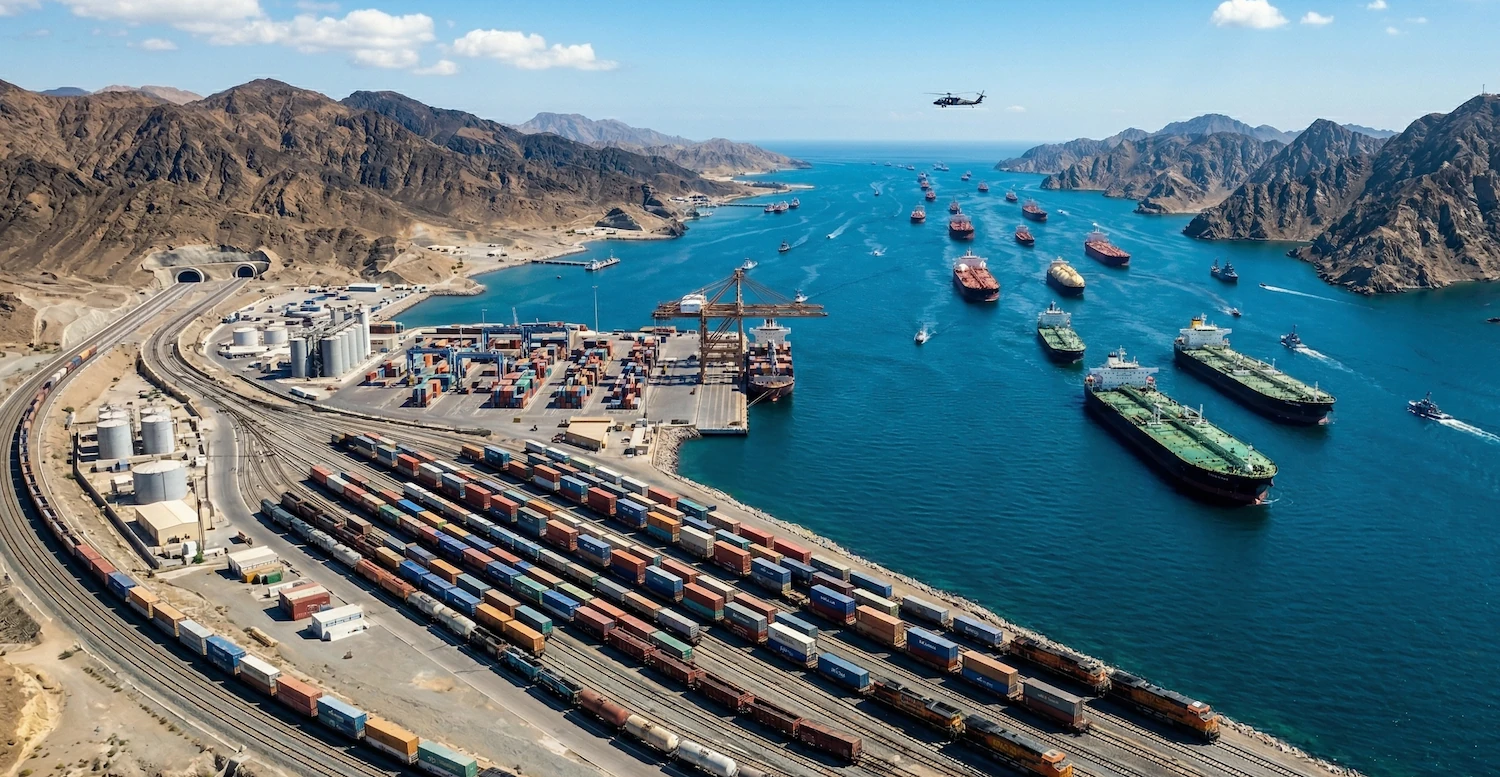
That warning proved prescient. On February 28, U.S. and Israeli forces launched joint military strikes against Iran. Within days, Iran's IRGC effectively closed the Strait of Hormuz to commercial shipping. Vessel transits dropped 95% from a peacetime average of roughly 138 per day to a trickle of shadow-fleet tankers navigating under a de facto tolling arrangement.
Roughly 20 million barrels per day of crude oil and 20% of global LNG normally transit Hormuz. Brent crude surged from approximately $72 per barrel pre-crisis to a peak of $126, with the IEA calling it the largest supply disruption in the history of the global oil market and authorizing release of 400 million barrels from emergency reserves.
For Gulf Coast rail-connected operations, the closure created an immediate split. Refining margins exploded: the 3-2-1 crack spread jumped from below $20 per barrel to over $54. Every producing LNG terminal on the Gulf Coast ran at maximum capacity. Valero restarted its Port Arthur 380,000-barrel-per-day facility.
The petrochemical picture is more nuanced. Naphtha-based feedstock costs have risen sharply, and 85% of Middle East polyethylene exports normally transit Hormuz. Fertilizer markets were hit immediately: urea prices at New Orleans surged 32% in a single week, from $516 to $683 per metric ton, as 30% of global urea and ammonia supply was disrupted. For rail operators, petroleum product carloads stand to gain further, while chemical carload growth faces a genuine stress test in Q2.
The Q4 2025 earnings season delivered profitability gains across the board — and a unanimous decision to pull back on spending. All six Class I railroads reduced their 2026 capital expenditure plans.
Union Pacific led in operating efficiency with a full-year adjusted operating ratio of 59.3% on $24.5 billion in revenue. CEO Jim Vena guided for mid-single-digit EPS growth from the $11.98 base but paused share repurchases to preserve balance sheet capacity for the proposed Norfolk Southern merger. UP's service metrics — car velocity of 236 miles per day and terminal dwell of 6.1 hours — were industry best.
BNSF earned $5.47 billion in net income on $23.3 billion in revenue. But Berkshire Hathaway's new CEO Greg Abel put BNSF on notice: the railroad's 65.5% operating ratio trailed Union Pacific's by 5.7 percentage points, and Abel declared that each one-percentage-point improvement generates approximately $230 million of incremental operating cash flow. BNSF's 2026 Texas program includes a new connection and siding at Dobbin on the Conroe subdivision and 1,400 miles of track surfacing.
CPKC delivered a record core adjusted operating ratio of 55.9% in Q4 on revenues of CAD $3.92 billion. CEO Keith Creel guided for mid-single-digit volume growth and low double-digit earnings growth in 2026. CSX reported full-year revenue of $14.09 billion and guided for 200–300 basis points of margin expansion. Norfolk Southern posted adjusted EPS of $12.75, up 10%, delivering over $215 million in productivity savings.
Perhaps the most consequential competitive shift in the Houston rail market is CPKC's emergence as a credible third option alongside UP and BNSF. Mexico-Canada traffic has grown from roughly 2% of CPKC's revenue in 2024 to nearly 3%, representing approximately half a billion dollars in new incremental revenue. Creel expects another $100 million in 2026.
Three infrastructure developments are expanding CPKC's Gulf Coast reach. The CPKC–CSX "Southeast Mexico Express" corridor is being upgraded to enable truck-competitive 30-hour Dallas-to-Atlanta service. Schneider National launched intermodal service over the route and now reports Mexico-to-Chicago transits running up to three days faster than the seven-day industry average, with 99.98% security rates.
The Patrick J. Ottensmeyer International Railway Bridge at Laredo has more than doubled cross-border rail capacity. In March, Texas awarded $58.51 million for a CPKC grade separation at Santa Maria Boulevard in Laredo — the largest single award from a new $250 million state rail fund. A July 2025 STB ruling confirmed CPKC's trackage rights to move grain from the Upper Midwest to Gulf Coast ports via UP track — opening a new competitive corridor for agricultural exports.
On February 20, the Supreme Court ruled 6–3 in Learning Resources, Inc. v. Trump that IEEPA does not authorize tariffs — invalidating duties estimated at $170–$179 billion in collections. Trump invoked Section 122 of the Trade Act of 1974 to impose a 10% global tariff effective February 24, capped at 15% and limited to 150 days.
For rail freight, the critical detail is in the exemptions. USMCA-compliant goods are exempt, providing significant relief for cross-border rail traffic that had faced 25–35% IEEPA duties. Section 122 tariffs expire July 24 unless Congress extends them. Twenty-four states filed legal challenges on March 13.
The practical impact on Q1 rail volumes was front-loading. Rail executives urged a cautious approach, noting significant pull-forward of freight for certain commodities in anticipation of tariffs. CPKC and CN both emphasized that nearshoring trends remain intact regardless of tariff outcomes — Mexico's own 5–50% tariffs on Asian imports are independently driving freight toward USMCA supply chains.
TGS is developing the Independence Rail Terminal in Deer Park, near the Houston Ship Channel, offering 650 railcar storage spots with transloading capabilities. Located near Beltway 8, Highway 225, Highway 146, and I-45, the facility is marketed for 2026 delivery and provides direct proximity to Ship Channel petrochemical operations.
Gulf Inland Logistics Park in Dayton — a 1,350-acre dual-served (BNSF and Union Pacific via CMC Railroad) development — completed Phase 1 with seven anchor tenants, 400-plus jobs, and $250 million in capital investment. Rail infrastructure is scaling to more than 2,000 railcar storage spaces by year-end 2026. In March, Serviacero USA purchased a rail-served site at Gulf Inland to establish its first U.S. manufacturing operations — a tangible example of nearshoring driving rail-connected industrial demand.
PSC Group's Bayport Terminal, already operating 850 railcar storage spaces on 115 acres, announced plans to add 300-plus additional car spaces, with approximately 60 undeveloped acres available for further expansion.
County Line Rail acquired the Sabine River & Northern Railroad, a 40-mile short line in East Texas connecting to three Class I railroads — CPKC, Union Pacific, and BNSF. The acquisition includes Mulford Yard and 100 acres of developable land. BNSF launched its Shortline Select program to improve service integration between Class I and short line operations. Texas committed $160.4 million in rail infrastructure grants, including $40 million for the Griggs-Long-Mykawa grade separation in Harris County.
On March 18, a Union Pacific train derailed 23 cars on the Glidden Subdivision near Richmond-Rosenberg, approximately 30 miles southwest of Houston. Five ethanol-laden tank cars leaked, prompting a multi-agency hazmat response. No injuries or evacuations were reported, but the NTSB opened an investigation and Amtrak's Sunset Limited was fully canceled.
PHMSA finalized HM-265, effective February 13, which modernizes cargo tank inspections and is expected to generate $145.3 million in annualized cost savings. The agency also extended the compliance deadline for HM-263's real-time electronic train consist data requirement to June 24, 2026.
PHMSA's December 2025 advance notice of proposed rulemaking on autonomous hazmat transport explicitly addresses rail regulations and seeks input on autonomous rail systems carrying hazardous materials. RJ Corman Railroad deployed Intramotev's TugVolt autonomous switching system on its Memphis Line in March — one of the first commercial deployments of self-propelled automatic rail vehicles for industrial switching.
The STB proposed to repeal its 1985 reciprocal switching regulations, restoring case-by-case discretion — a development cheered by captive chemical shippers. The Board also rejected Union Pacific's merger application with Norfolk Southern as incomplete, though UP may refile by June 22.
Port Houston opened 2026 with its largest January on record: 370,034 TEUs, up 4% year-over-year. February data showed continued momentum: total cargo up 5%, with dry bulk surging 28% and liquid bulk 31%, though steel imports declined 27%.
Project 11 reached 76% completion, with Port Houston eliminating century-old nighttime vessel movement restrictions. The Port Commission approved Bayport Wharf 1 construction — 1,300 linear feet of new berthing capacity — and took delivery of six new rubber-tired gantry cranes, bringing its fleet to 163 RTGs.
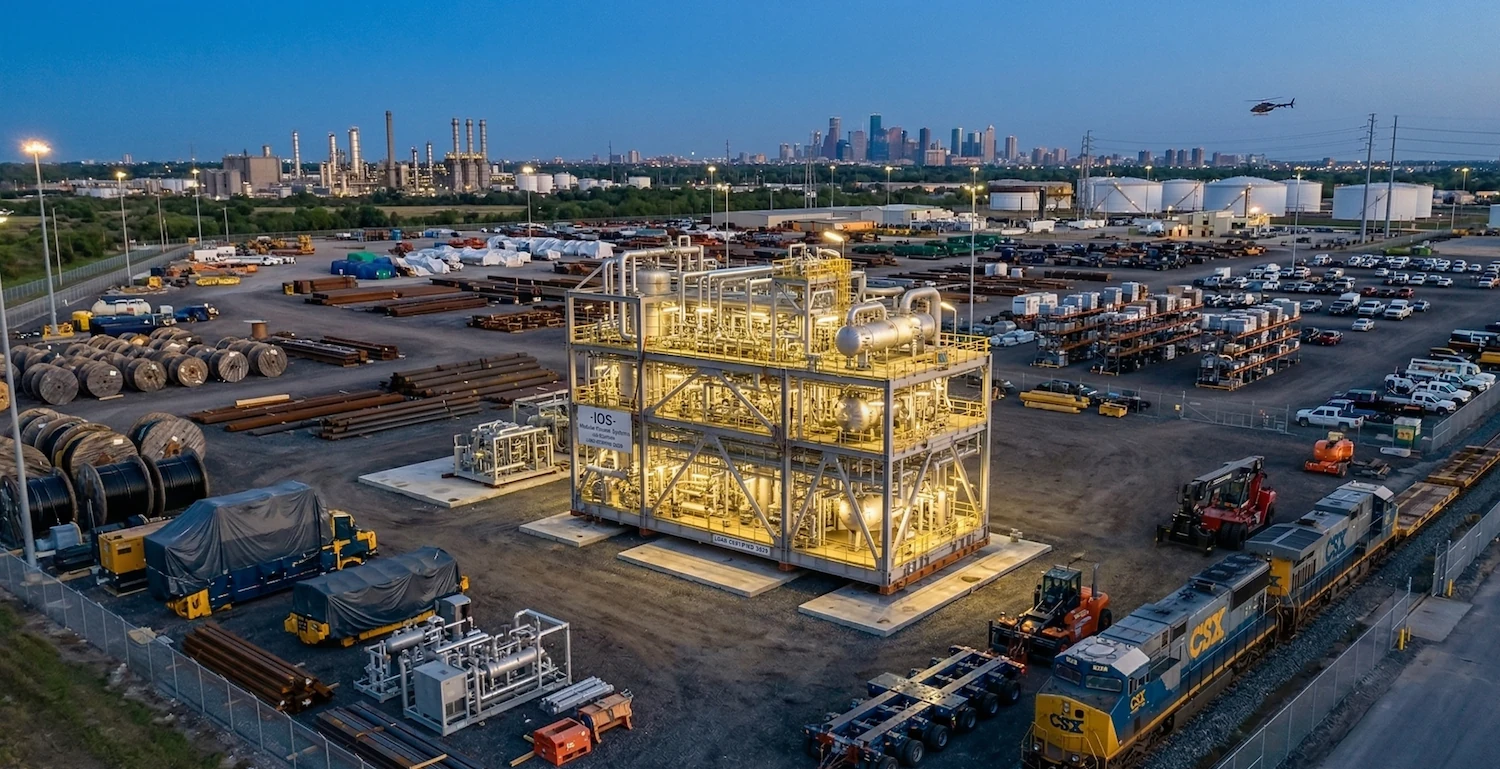
In industrial outdoor storage, Apricus Realty Capital acquired a 9.2-acre IOS facility in Channelview leased to GFL Plant Services. Dalfen Industrial acquired two IOS assets totaling 8.9 acres near Highway 225. A notable emerging trend is electrified IOS (EIOS): J.P. Morgan Asset Management reports tenants paying 20–30% rent premiums for powered, turnkey sites.
Major rail-using industrial projects continue advancing. Golden Triangle Polymers expects startup in 2026 with a 2,080 KTA ethane cracker and two HDPE units. Enterprise Products is expanding its Ship Channel export terminal with approximately 300,000 barrels per day of LPG export capacity by year-end.
The railroad industry achieved a rare period of labor stability in Q1. Under the 18.8% five-year pattern agreement, eleven unions ratified twelve national agreements covering more than 75% of rail union employees. The cycle continued into 2026 with the NCCC-IAM reaching a tentative agreement on March 31 covering approximately 4,900 members, and TCU ratifying a BNSF intermodal agreement on April 1 covering 746 employees. Combined with the 2022 round's 24% increase, these contracts deliver roughly 50% compounded wage growth from 2020 to 2029.
The industry's operating philosophy has evolved meaningfully. CPKC's record 55.9% Q4 operating ratio edges UP's 59.3% full-year figure. Norfolk Southern's proprietary wheel integrity system triggered an industry-wide wheel recall. The STB's new mandated service metrics are creating unprecedented transparency. Greg Abel's pointed demand that BNSF close its efficiency gap suggests even the holdout is feeling the pressure.
Q1 2026 delivered record chemical carloads, meaningful new rail terminal capacity, and a genuinely altered competitive landscape — all before the Hormuz crisis introduced the most significant supply-side energy shock in a generation. The crisis has bifurcated the outlook: refiners and LNG exporters are running flat out into historic margins, while petrochemical producers face rising feedstock costs that could test the chemical carload streak by mid-year.
New capacity — from TGS Independence to Gulf Inland's 2,000-car yards to PSC Bayport's expansion — is arriving at a moment when both risk and opportunity are running at elevated levels. The operators best positioned for Q2 will be those with diversified commodity exposure, flexible rail access across multiple Class I carriers, and the infrastructure to capitalize on whatever the Hormuz resolution delivers next.
Ameritank's 147-acre La Porte facility offers direct Union Pacific rail service with unit train capability, deepwater barge access on the Houston Ship Channel, 840 MW of power capacity, and 4 billion gallons of annual water access — multimodal infrastructure purpose-built for the commodity flows reshaping Gulf Coast logistics. Connect with the Ameritank team.

Andrew Viera
Business Development Executive, Ameritank
Andrew manages offtaker relationships, capital partnerships, and strategic positioning for Ameritank's 147-acre terminal on the Houston Ship Channel. He works across terminal development, investor relations, and market analysis to connect infrastructure capacity with commodity demand across the Gulf Coast energy corridor.