Loading articles...
Related articles
The Strait of Hormuz closure tripled Gulf Coast crack spreads and turbocharged barge demand — then a 60-day Jones Act waiver opened domestic waterways to foreign-flag competition. This Q1 2026 briefing covers the refinery demand surge, the waiver's unprecedented scope and AWO's response, Arcosa's $450M barge manufacturing exit, Hines Furlong Line's Campbell acquisition, Kirby and Genesis guidance, GIWW dredging contracts, Colorado River Locks repairs, IIJA expiration risk, new terminal permits, Tier IV propulsion milestones, USCG cybersecurity compliance, and the chemical barge outlook.
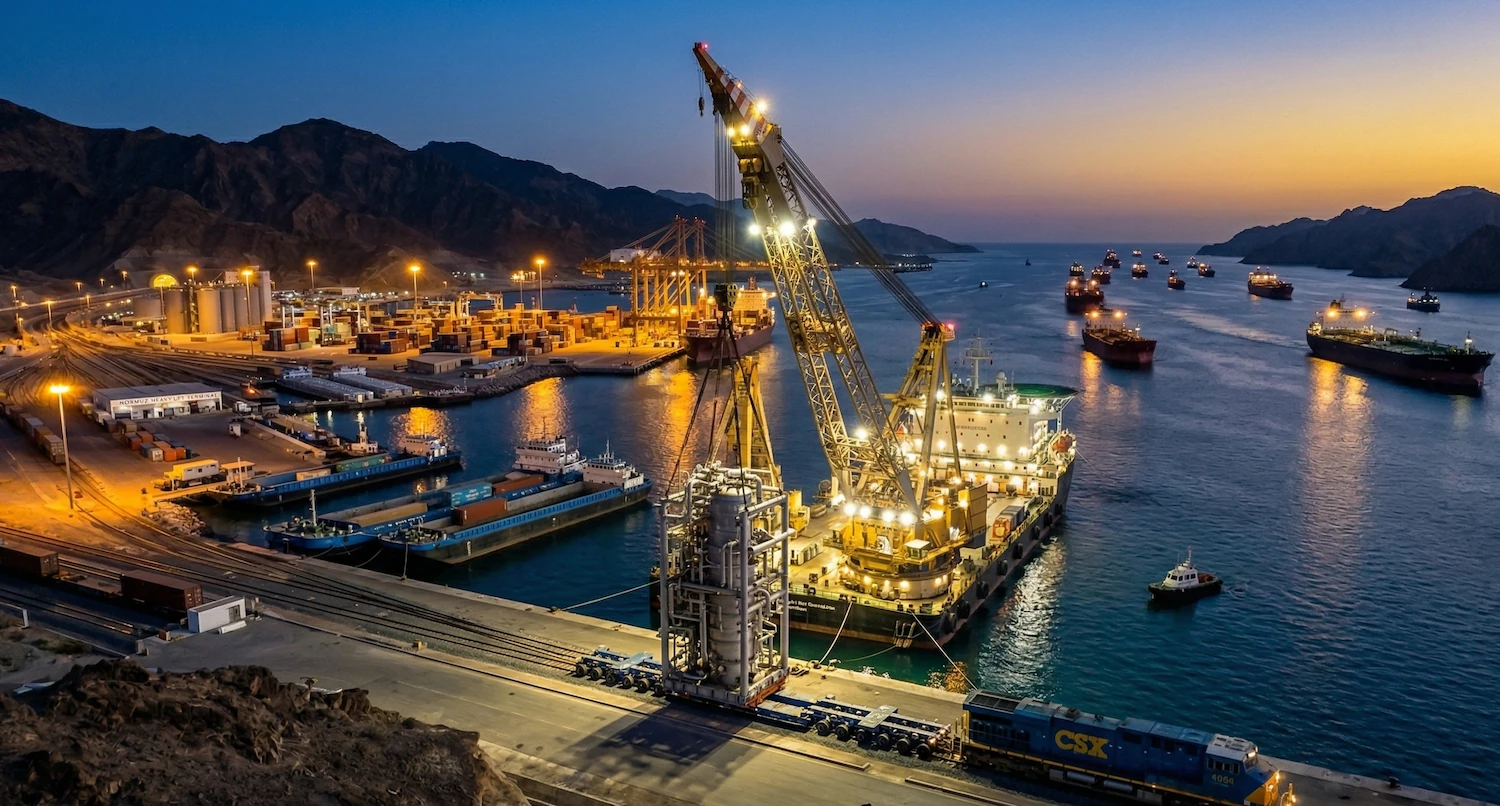
The Gulf Coast inland barge market enters Q2 2026 caught between two massive crosscurrents: a geopolitical shock that has turbocharged demand and a regulatory action that threatens the industry's competitive moat. The effective closure of the Strait of Hormuz in late February drove Gulf Coast refinery crack spreads from under $20 per barrel to over $54 — the strongest margin environment since 2022 — while a sweeping 60-day Jones Act waiver signed March 17 opened domestic waterways to foreign-flag competition for the first time in modern memory. For barge operators on the Houston Ship Channel and Gulf Intracoastal Waterway, these developments create a paradox: surging cargo demand meets existential policy risk.
Before Operation Epic Fury's airstrikes on February 28, the Gulf Coast barge market faced headwinds. Refinery utilization had drifted into the mid-80% range from 93% at the start of 2025. Crack spreads had fallen more than 45% from 2022 peaks. Houston Ship Channel refineries were running at reduced rates not because of maintenance but because the economics didn't support full capacity.
Iran's retaliation changed everything. Commercial vessel crossings through the Strait dropped 95%, removing roughly 20 million barrels per day from market access. Brent crude surged from the low $70s to $126 at peak. The Brent-WTI spread widened past $10 per barrel, creating powerful incentives for Gulf Coast refiners to source cheaper domestic crude delivered by pipeline and barge.
The reversal for barge demand was immediate. Valero began restarting its 380,000 barrel-per-day Port Arthur facility into crack spreads nearly triple those of early 2026. U.S. fuel exports hit a record high in March. LNG terminal utilization across the Houston-to-Brownsville corridor surged. Energy Transfer launched a flash open season for the Bayou Bridge Pipeline starting May 2026 to move more domestic crude to Louisiana refineries.
For tank barge operators, the math is straightforward: higher refinery throughput means more feedstock delivery and product distribution, much of which moves by barge. Vortexa analysis shows Atlantic basin crude flows redirecting to fill the Middle East vacuum, with U.S. Gulf Coast exports capturing the lion's share of displaced demand.
On March 17, the Trump administration issued a 60-day Jones Act waiver under 46 U.S.C. § 501(a) at the request of the Department of War. The waiver expires May 17 at 11:59 PM EDT.
What alarmed the barge industry was the waiver's breadth. It covers all foreign-flag vessel types — including barges and tug-barge units — not just oceangoing tankers. CBP guidance confirms it permits coastwise trade in at least 659 product categories by HTS number, spanning crude oil, refined petroleum products, LNG, fertilizer, coal, and renewable fuels. It imposes no route or geographic restriction. Critically, it was issued under Section 501(a) — a national defense justification that requires no MarAd survey of domestic vessel availability.
AWO President Jennifer Carpenter called it an "all-hands-on-deck operation," urging the largest-ever turnout for the Spring Convention Barge-In on Capitol Hill. AWO's official statement declared the waiver puts both supply chain reliability and national security at risk. Nine maritime labor organizations issued a joint statement calling the waiver unnecessary and ineffective.
The industry's strongest counterargument is economic. An AMP-commissioned study found the maximum gasoline price impact would be $0.0027 per gallon — less than a third of a penny. With international VLCC rates at $423,736 per day, foreign-flag vessels would actually cost more on domestic routes. Early market data supported this: a foreign-flag MR tanker was chartered for a Gulf Coast-to-Jacksonville voyage at approximately $6.74 per barrel, above typical Jones Act rates.
The most significant structural development of Q1 was Arcosa Inc.'s sale of its entire barge manufacturing business to Wynnchurch Capital for $450 million in cash, announced February 27. Arcosa Marine Products generated $383 million in revenue and $68 million in EBITDA in 2025, with a strong backlog providing production visibility deep into 2026.
This transaction matters enormously for barge supply dynamics. With only two major inland barge builders, the sale to a private equity firm raises questions about future capital allocation and construction capacity at the precise moment when fleet aging demands accelerated replacement. Roughly 40% of the inland barge fleet — 8,577 barges — is now over 20 years old, and 25% exceeds 25 years.
Hines Furlong Line closed its acquisition of Campbell Transportation's river division on January 30, creating a combined operation of 800-plus employees, 800-plus barges, 64 towboats, and 1,000 fleeting spaces along the full Ohio River system. HFL President Kent Furlong framed the deal as a response to an industry increasingly shaped by operators with diversified fleets and the scale to invest for the long term.
Kirby Corporation's January 29 guidance — delivered weeks before Hormuz — set a cautiously optimistic tone. Inland utilization had improved into the low 90% range early in Q1. Full-year EPS guidance of $6.33 to $7.09 assumed low-to-mid-single-digit inland revenue growth and operating margins averaging high-teens to low 20%. CEO David Grzebinski emphasized that spot rates appeared to have reached a floor with early signs of firming. Kirby's coastal utilization was projected in the mid-90% range, with continued shortage of large-capacity chemical equipment. Q1 2026 earnings are due April 30.
Genesis Energy reported Q4 2025 results showing its marine transportation segment returning to more normalized performance, with inland heater barge demand recovering as Gulf Coast refiners increased heavy crude runs. Genesis guided to 15–20% adjusted EBITDA growth for 2026, issued $750 million in senior notes, expanded its revolver to $900 million, and repurchased $110 million in preferred units.
Several operators expanded fleets. Magnolia Marine Transport added 3 towboats and 9 barges in March. Canal Barge Company took delivery of the Al Sloss — the first in a series of four 2,600-hp inland pusher tugs featuring EPA Tier IV compliant diesel exhaust fluid systems, a first for builder C&C Marine. Marquette Transportation christened a new 10,000-horsepower towboat on January 10.
Federal waterway infrastructure funding hit notable milestones in Q1. The FY2026 Energy and Water Development appropriations provided over $10 billion for Army Corps Civil Works. Navigation received $2.99 billion, including $918 million for inland and intracoastal waterway operations and maintenance. However, the President's FY2026 budget requested just $9 million for inland waterway construction and zero from the Inland Waterways Trust Fund.
On the GIWW specifically, USACE's Galveston District awarded a $10.27 million contract to Inland Dredging Company on February 3 for maintenance pipeline dredging from High Island to Causeway with Chocolate Bayou. The Houston Ship Channel received $53.6 million in FY2026 O&M funding plus $161 million for Project 11 expansion. Port Houston secured Federal Assumption of Maintenance for HSC Segment 1B, projecting savings of approximately $300 million over 50 years.
The Colorado River Locks underwent a brief closure March 25–26 for welding repairs but continue 24/7 operations enabling transit of 12,000-plus tows and 20 million tons annually. A looming concern: the IIJA authorization expires September 30, 2026, and ASCE's 2025 Infrastructure Report Card found that cost overruns will make IIJA funding insufficient to complete any of the seven priority inland waterway projects.
At its March 23 meeting, the Port Houston Commission approved a marine construction permit for ExxonMobil to build a new ship dock and dredged basin for petrochemical load-out to ships and barges. Port Houston's FY2026 plans include roughly 45 infrastructure projects valued at $365 million, supported by a $726 million operating budget.
Texas GulfLink received its MARAD license January 29 to construct a crude oil export terminal approximately 30.5 miles offshore. Enterprise's Sea Port Oil Terminal (SPOT) off Freeport could begin operations between H2 2026 and early 2027. The Galveston LNG Bunker Port at Shoal Point secured final federal permits, with a TOTE Services partnership for the first Jones Act LNG bunker vessel.
Community scrutiny of barge operations is intensifying. A March 5 town hall in Channelview attracted over 100 attendees concerned about health risks from barge fleeting on the San Jacinto River, with a former TCEQ scientist stating barge emissions may be significantly underestimated.
No electric, hydrogen, or methanol-powered barges were deployed on the Gulf Coast in Q1 2026 — these developments remain concentrated in Europe, where the world's first hydrogen-fueled inland vessel completed sea trials in the Netherlands. However, the regulatory trajectory is unmistakable.
Canal Barge's Tier IV-compliant Al Sloss represented a concrete milestone. Devall Diesel launched a new Barge Power Pack engine system in March featuring an FPT mechanical engine certified for Class 1, Division 1 explosive environments, delivering up to 30% fuel savings over Tier 2 predecessors. The EPA's Tier 4 relief provision for marine engines rated 600–1,000 kW expires in model year 2026.
AWO submitted comments to EPA on March 27 requesting a virtual public hearing on California's Commercial Harbor Craft rule, arguing that diesel particulate filter requirements are unsafe on vessels. While California-specific, the rule signals where federal regulation may eventually trend.
The Coast Guard's Cybersecurity in the Marine Transportation System rule hit its first major compliance deadline on January 12, 2026, requiring all personnel with IT/OT system access to complete cybersecurity training. The rule applies to towing vessels and barges — the USCG explicitly rejected requests to exclude inland operators. Cybersecurity plans must be submitted by mid-2027.
AWO's January 20, 2026 letter to the incoming administration outlined the industry's legislative and regulatory priorities, including Jones Act defense, WRDA 2026, workforce development, and opposition to new EPA emissions mandates. The March 5 letter pivoted to crisis management as the Hormuz situation and Jones Act waiver dominated the agenda. The House Transportation and Infrastructure Committee is actively developing WRDA 2026 — the seventh consecutive biennial Water Resources Development Act.
AWO and the American Chemistry Council renewed their Memorandum of Agreement on February 18 aligning the Responsible Carrier Program with Responsible Care® standards — reducing duplicative safety audits across chemical barge operations and strengthening the safety framework for the industry's largest commodity segment.
Kirby projected that petrochemical customer demand would improve in 2026, and the coastal chemical barge segment remains particularly tight with a continued shortage of large-capacity equipment. Gulf Coast petrochemical maintenance spending exceeded $480 million in Q1 2026, including major turnarounds at BASF Port Arthur and Chevron Phillips ethylene units — temporarily reducing production but generating demand for barge movements of intermediate products.
The biggest demand catalyst ahead is Golden Triangle Polymers — the CPChem/QatarEnergy joint venture in Orange, Texas featuring a 4.6 billion pound-per-year ethane cracker plus two HDPE units. Expected operational in 2026, this facility will generate significant waterborne chemical logistics demand. Broader structural tailwinds include petrochemical feedstock demand growing 3–4% annually even as transportation fuel demand flattens.
The Gulf Coast barge market in Q1 2026 is defined by a rare convergence: geopolitical crisis driving unprecedented refinery demand, a Jones Act waiver creating existential policy uncertainty, and structural tightening from fleet aging and limited construction capacity. The Hormuz-driven surge — crack spreads tripling, fuel exports hitting records, refiners restarting idled capacity — should deliver the strongest tank barge demand environment in years when Kirby reports Q1 results on April 30.
The Arcosa sale to Wynnchurch Capital for $450 million concentrates barge manufacturing further at a moment when 40% of the fleet exceeds 20 years. The IIJA authorization's September 2026 expiration and acknowledged cost overruns on all seven priority waterway projects cast a shadow over the inland waterway capital pipeline. The operators that emerge strongest will be those with fleet scale, customer diversification across petroleum and chemicals, and the balance sheet flexibility to navigate what may be the most volatile operating environment in a generation.
Ameritank's 147-acre La Porte facility offers direct Houston Ship Channel barge access with a deepwater barge dock, 840 MW of power capacity, Union Pacific rail, and 4 billion gallons of annual water access — multimodal infrastructure purpose-built for the petroleum and chemical movements driving Gulf Coast barge demand. Connect with the Ameritank team.

Andrew Viera
Business Development Executive, Ameritank
Andrew manages offtaker relationships, capital partnerships, and strategic positioning for Ameritank's 147-acre terminal on the Houston Ship Channel. He works across terminal development, investor relations, and market analysis to connect infrastructure capacity with commodity demand across the Gulf Coast energy corridor.