Project 11's Galveston Bay widening is complete. Over $10 billion in NGL export capacity is under construction. Land along the channel has nearly tripled in price, and new-build costs now exceed $100 per barrel. This analysis covers what Houston Ship Channel terminal operators need to understand about capacity, competition, tariffs, and the approaching contango cycle heading into 2026.
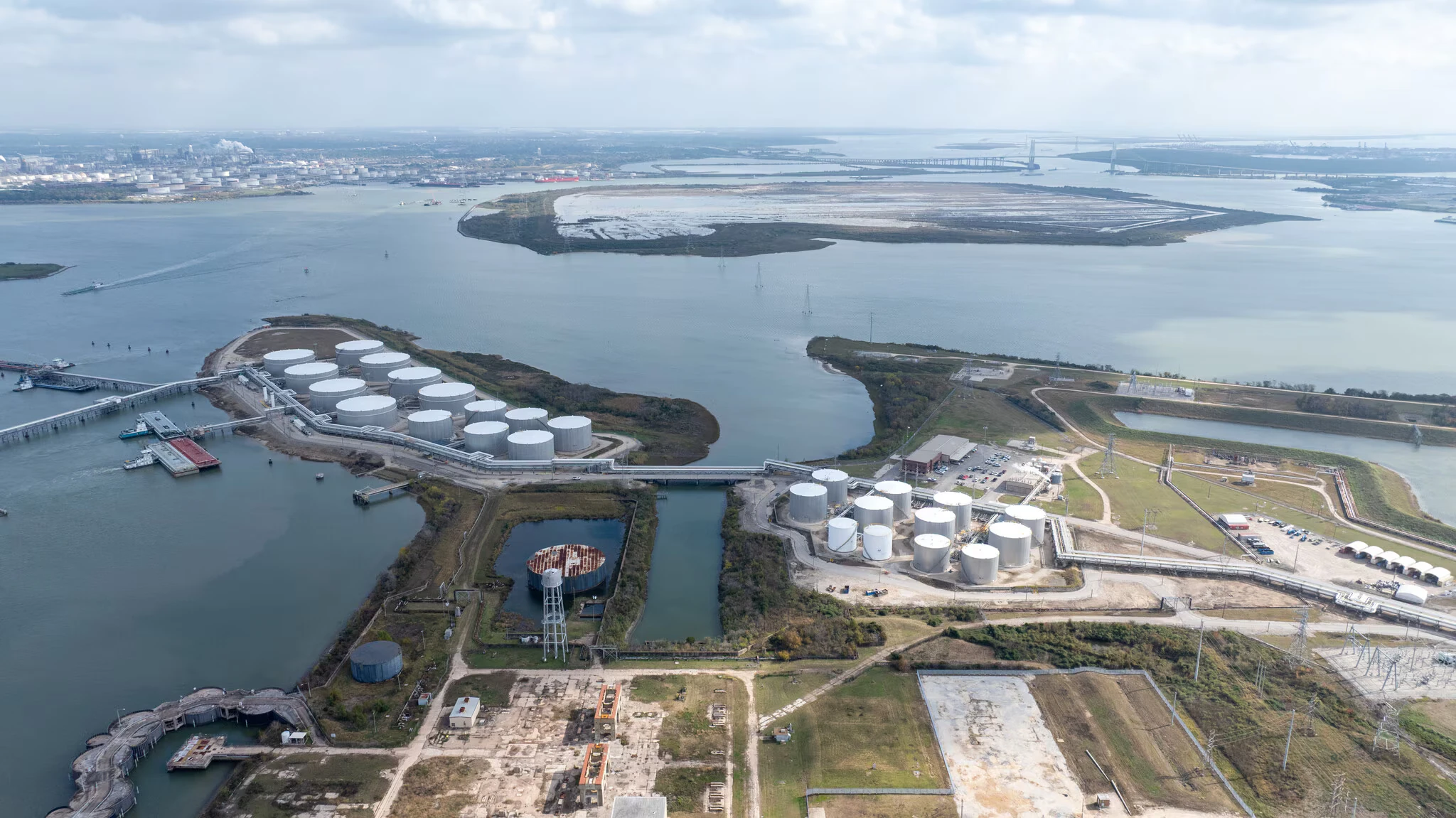
The Houston Ship Channel is undergoing its most consequential transformation in decades. Project 11's widening of the Galveston Bay reach to 700 feet is now complete. Over $10 billion in NGL export capacity is under construction or committed through 2028. Industrial land along the channel has nearly tripled in price. New-build terminal costs have surged past $100 per barrel. And a 45,000-to-50,000 craft worker shortfall on the Gulf Coast is extending project timelines by months.
For terminal operators evaluating expansion, acquisition, or greenfield development on the Houston Ship Channel, the window for capturing strategic positioning is narrowing — and the penalty for moving too slowly is measured in years and hundreds of millions of dollars.
The most important fact about Project 11 that many industry participants get wrong: this is primarily a widening project, not a deepening project. The Galveston Bay reach maintains its existing authorized depth of approximately 45 feet. Only the upper channel segments — Boggy Bayou to the Turning Basin — are being deepened from 41 feet to 46.5 feet MLLW. VLCCs, which require 66–75 feet of draft fully loaded, remain physically impossible to accommodate in the Houston Ship Channel regardless of Project 11's completion.
What Project 11 does deliver is transformative for vessel throughput. The Galveston Bay reach widened from 530 feet to 700 feet across all three Port Houston-led sub-segments, completed in September 2025. Segment 1A (Bolivar Roads to Redfish Reef, 11.5 miles) was accepted by USACE in March 2023. Segment 1B (Redfish Reef to Bayport, 8.3 miles) followed in January 2025. Segment 1C wrapped up in Q3 2025.
On October 27, 2025, Port Houston formally announced the removal of daylight restrictions for vessels transiting Galveston Bay.
That milestone adds up to 2.5 hours of daily transit availability for oversized vessels.
The remaining USACE-led segments are still under construction. Package 7 — Barbours Cut Channel widening to 455 feet with an 1,800-foot diameter turning basin — received notice to proceed in February 2025.
McCarthy Building Companies mobilized dredging in September 2025, with approximately 2.8 million cubic yards to be removed. Segments 4–6 (upper channel deepening and widening from 400 to 530 feet) remain in design phase. Full project completion is targeted for 2029.
The budget tells the story of how seriously this project is being prioritized. Port Houston has contributed over $600 million — well beyond its customary 25% cost-share. The FY2026 federal budget allocated $161 million for construction and $53.6 million for operations and maintenance. In June 2025, Port Houston declared Project 11 "funded to completion"
Total project cost exceeds $1 billion. A proposed channel user fee averaging $4,725 per vessel transit in Year 1 (escalating 3% annually) is under development, with container ships paying roughly $8,893 per transit, tankers approximately $5,665, and chemical tankers about $2,321.
For terminal operators, the throughput economics are straightforward. The 170-foot widening enables safe two-way traffic for Suezmax tankers (carrying approximately 1 million barrels) and post-Panamax container ships simultaneously — eliminating one-vessel-per-week restrictions that previously limited neo-Panamax access.
The Houston Ship Channel hosts over 200 private and 8 public terminals with a conservative estimate of 100-plus million barrels of independent third-party liquid storage capacity. But that aggregate number masks sharp divergences by product segment.
Specialty chemical storage is the tightest segment. Odfjell Terminals Houston has been operating at or near full capacity for years, which directly drove its Bay 13 expansion — nine new tanks adding 32,400 cubic meters (204,000 barrels) commissioned in early 2024.
That brought total capacity to 413,400 cubic meters across 128 tanks. Odfjell's undeveloped "Point" site offers approximately 140,000 cubic meters of additional expansion capacity.
Finished fuels storage is also strong. ITC's Pasadena terminal reported throughput up 20% year-over-year in 2025.
ITC is expanding aggressively: 13 additional tanks at Deer Park will add 1.3 million barrels, with a stated goal of reaching 26 million barrels of total Houston Ship Channel capacity by 2030 from the current 21 million.
The market structure shift that every terminal operator should be watching is the emerging contango in crude and refined product forward curves. Through most of 2025, oil markets traded in backwardation, suppressing storage-play demand. By late Q3 2025, Brent forward curves began showing contango developing into 2026, with the IEA estimating a roughly 3-million-barrel-per-day global oversupply.
Other operators expanding or entering the channel now include:
Vopak Exolum Houston — the first greenfield terminal on the Houston Ship Channel in over a decade, now operational with ammonia storage and a VLGC-capable deepwater berth.
Vopak Exolum is building a new greenfield terminal designed for chemical and ammonia storage.
TexasDeepwater Partners (USDG/Pinto Realty JV) is developing a 988-acre site on the channel capable of supporting up to 10 million barrels of storage with unit-train rail access.
U.S. NGL exports hit 3.1 million barrels per day in 2025 — a record, up 7% year-over-year.
The Gulf Coast handles virtually all of this volume, and the Houston Ship Channel processed 57% of all U.S. LPG exports in 2024.
The capacity buildout underway is staggering. Enterprise Products is adding 300,000 BPD of dedicated LPG refrigeration at its Enterprise Hydrocarbons Terminal, targeting service by end of 2026.
The most significant new entrant is the ONEOK/MPLX joint venture at Texas City — a $1.4 billion, 400,000 BPD LPG export terminal targeting early 2028 completion
Energy Transfer's $1.25 billion Flexport expansion at Nederland — adding 250,000 BPD of LPG, ethane, and ethylene capacity with a fourth dock now operational — shifted Energy Transfer to 35% of total U.S. NGL exports in January–November 2025, overtaking Enterprise's 34%
The ethane segment faces a unique disruption. China accounts for 47% of U.S. ethane exports, and new U.S. export licensing requirements halted ethane shipments to China after May 23, 2025. Ethane ending stocks reached an all-time high of 80.9 million barrels in July 2024.
PADD 3 dock utilization approached 100% during the 2024–2025 winter season, per East Daley Analytics, with spot dock rates surging to double-digit cents per gallon versus typical rates of $0.07/gallon
Combined planned capacity additions across the Gulf Coast exceed 1.5 million BPD through 2028, but until that capacity is fully operational, storage and dock access premiums will remain elevated — creating margin opportunity for operators with available capacity.
Port Houston closed 2025 as a record year: 54.5 million short tons across public terminals (+3%), 4.3 million TEUs (+4%), with loaded exports up 7%.
January 2026 set a new monthly record at 370,034 TEUs. The channel's total cargo throughput across all 200-plus terminals reached 309.5 million short tons per the latest USACE data, a 5.3% increase. Houston remains America's number-one port by total waterborne tonnage, with a gap over the number-two port of 92 million tons
IEEPA-based tariffs — including the 145% peak rate on Chinese goods — were struck down by the Supreme Court on February 20, 2026.
The administration imposed replacement tariffs of 10–15% under Section 122 of the Trade Act, effective for 150 days through July 24, 2026. Section 301 tariffs (10–25% on over 1,500 Chinese chemicals since 2018) and Section 232 steel tariffs at 50% remain in effect. Critically, the administration has signaled Section 232 investigations into batteries, chemicals, and plastics — a development that could fundamentally alter Gulf Coast petrochemical trade economics.
Energy products — crude oil, LNG, and most refined products — were largely exempt from all tariff actions, insulating Houston's dominant export sector. But U.S. polyethylene exports to China dropped to a 16-month low in April 2025 when Chinese retaliatory tariffs hit 125%.
The practical response for terminal operators is accelerating FTZ utilization. Port Houston manages FTZ 84, one of the largest and most active Foreign Trade Zones in the United States
Port Houston reported a noticeable increase in FTZ inquiries during 2025. The tariff mitigation benefits are substantial: no duty on merchandise exported from the zone, deferred duties on stored goods, and the ability to manufacture, blend, and repackage within the zone. For operators handling imported petrochemical feedstocks or chemical intermediates, FTZ designation has shifted from a nice-to-have to a competitive necessity.
Ameritank operates within FTZ 84 at its 147-acre facility in La Porte.
The longstanding industry benchmark of approximately $60 per barrel installed cost for a new tank terminal is no longer achievable. Adjusted for 50% Section 232 steel tariffs, construction labor inflation, and supply chain disruptions, realistic all-in costs now run $65–$120 per barrel for a mid-complexity crude or refined products terminal on the Gulf Coast.
Steel is the primary cost driver. U.S. hot-rolled coil pricing has followed a volatile upward trajectory: roughly $694/ton in January 2025, peaking at $967/ton in April 2025 after the initial tariff, and climbing to approximately $1,005/ton by March 2026 under the 50% tariff regime.
Chinese domestic HRC trades at roughly $410/metric ton — a greater-than-100% differential. A large crude oil storage tank requiring 1,000–5,000 tons of API 650 plate faces $1 million to $5.5 million in steel costs alone before fabrication and erection.
Land scarcity compounds the cost challenge. According to Bisnow, only five large industrial sites remain available near the Houston Ship Channel.
Land costs in the southeast Houston market — Pasadena, Deer Park, La Porte — have nearly tripled over the past eight years. Manufacturing vacancy in the area stands at just 2.2%, with industrial rents at a record $10.67 per square foot NNN in Q4 2025.
The labor shortage is arguably the single greatest execution risk. Bechtel projects a 45,000-to-50,000 craft worker shortfall on the U.S. Gulf Coast, with approximately 1,200 miles of active construction competing for the same workforce.
Eighty-one percent of open-shop firms report difficulty filling hourly craft positions.
The economics still work under the right conditions. Analysis of 20 prior terminal projects shows that achieving monthly fill-and-empty cycles at a $1.50-per-barrel spread yields a 10% IRR with reasonable utilization.
Recent midstream M&A has priced terminal assets at 10.5x to 12x EBITDA. Median acquisition prices are $64/barrel for crude oil terminals and $48/barrel for refined products — both below current new-build costs.
This makes acquisitions of existing assets potentially more attractive than greenfield development for operators seeking near-term capacity.
Enterprise Products remains the dominant integrated operator. Its Enterprise Hydrocarbons Terminal complex features 18 ship docks, 8 barge docks, access to approximately 125 pipelines, and roughly 400 million barrels of system-wide storage. The company has $5.6 billion in major capital projects under construction.
Kinder Morgan holds the largest third-party refined products position with approximately 43 million barrels across its Pasadena and Galena Park complex. A $170 million investment enhanced flow rates, expanded MTBE handling, and added a butane-on-demand blending system.
KMI's strategic capital allocation is shifting toward natural gas: its $9.3 billion project backlog is 93% gas-focused.
The most consequential M&A event of 2025 was Mitsui O.S.K. Lines' acquisition of LBC Tank Terminals for approximately $1.715 billion, completed June 30, 2025.
LBC Houston operates over 3.9 million barrels with 189 tanks and 29 proprietary pipelines.
MOL's stated strategy — building a "Total Chemical Logistics Service" and positioning in ammonia and CO2 supply chains — signals that LBC's Houston asset will increasingly orient toward energy transition cargoes.
On the cautionary side, BWC Terminals faces operational and reputational challenges after a December 27, 2025 incident at its Jacintoport terminal where a catwalk collapse ruptured a sulfuric acid line connected to a 25,000-barrel tank.
The EPA's finalized HON Rule (April 2024) targeting emissions of ethylene oxide, chloroprene, benzene, and other hazardous air pollutants affects approximately 218 existing facilities, with nearly 40% in Texas and 14% in Harris County.
While the Trump EPA announced reconsideration in March 2025, the underlying requirements for fenceline monitoring represent structural compliance costs.
At the state level, Harris County's PM2.5 non-attainment designation and Greater Houston's reclassification to severe ozone non-attainment create compounding permitting constraints.
The severe ozone designation dropped the major source threshold back to 25 tons per year of VOCs — a level that catches many terminal operations previously permitted under the moderate classification at 100 tons per year. Growing legal challenges to air permits signal an increasingly contentious permitting environment.
The Houston Ship Channel's value proposition is unassailable at the macro level: number-one U.S. port by tonnage, 57% of U.S. LPG exports, the nation's largest petrochemical complex, and a newly widened 700-foot channel. But the micro-level execution environment — land scarcity, $100-plus-per-barrel construction costs, severe labor shortages, tightening environmental permitting, and a volatile tariff regime — means that the competitive advantage now accrues overwhelmingly to operators who already hold permitted, connected, infrastructure-rich positions on the channel.
The emerging contango in crude and refined product markets heading into 2026, combined with NGL export capacity additions of over 1.5 million BPD through 2028, creates a dual demand signal for storage: throughput-driven demand from the export boom and structure-driven demand from the shifting forward curve. Operators positioned to capture both — with multimodal connectivity, FTZ designation, and permitted expansion capacity — are entering what may be the most favorable terminal economics cycle in a decade.
Those still evaluating from the sidelines face a market where the five remaining large industrial sites will likely be committed within 18–24 months, and the construction cost trajectory shows no signs of reversal.
Ameritank's 147-acre facility in La Porte sits within this inflection point — with 840 MW of power capacity, 4 billion gallons of annual water access, Union Pacific rail, deepwater barge dock, multiple pipeline crossings, and FTZ 84 designation on one of the last large connected sites on the Houston Ship Channel.

Andrew Viera
Business Development Executive, Ameritank
Andrew manages offtaker relationships, capital partnerships, and strategic positioning for Ameritank's 147-acre terminal on the Houston Ship Channel. He works across terminal development, investor relations, and market analysis to connect infrastructure capacity with commodity demand across the Gulf Coast energy corridor.