Loading articles...
Related articles
The Houston Ship Channel generates over 100 million gallons per day of industrial wastewater from 200+ facilities. PFAS CERCLA liability now attaches to every handler. TCEQ overhauled its compliance history framework in February 2026. Treatment costs run $5–$14 per barrel through third parties. This analysis covers the permitting, economics, technology, and water scarcity data that terminal operators and industrial investors need.
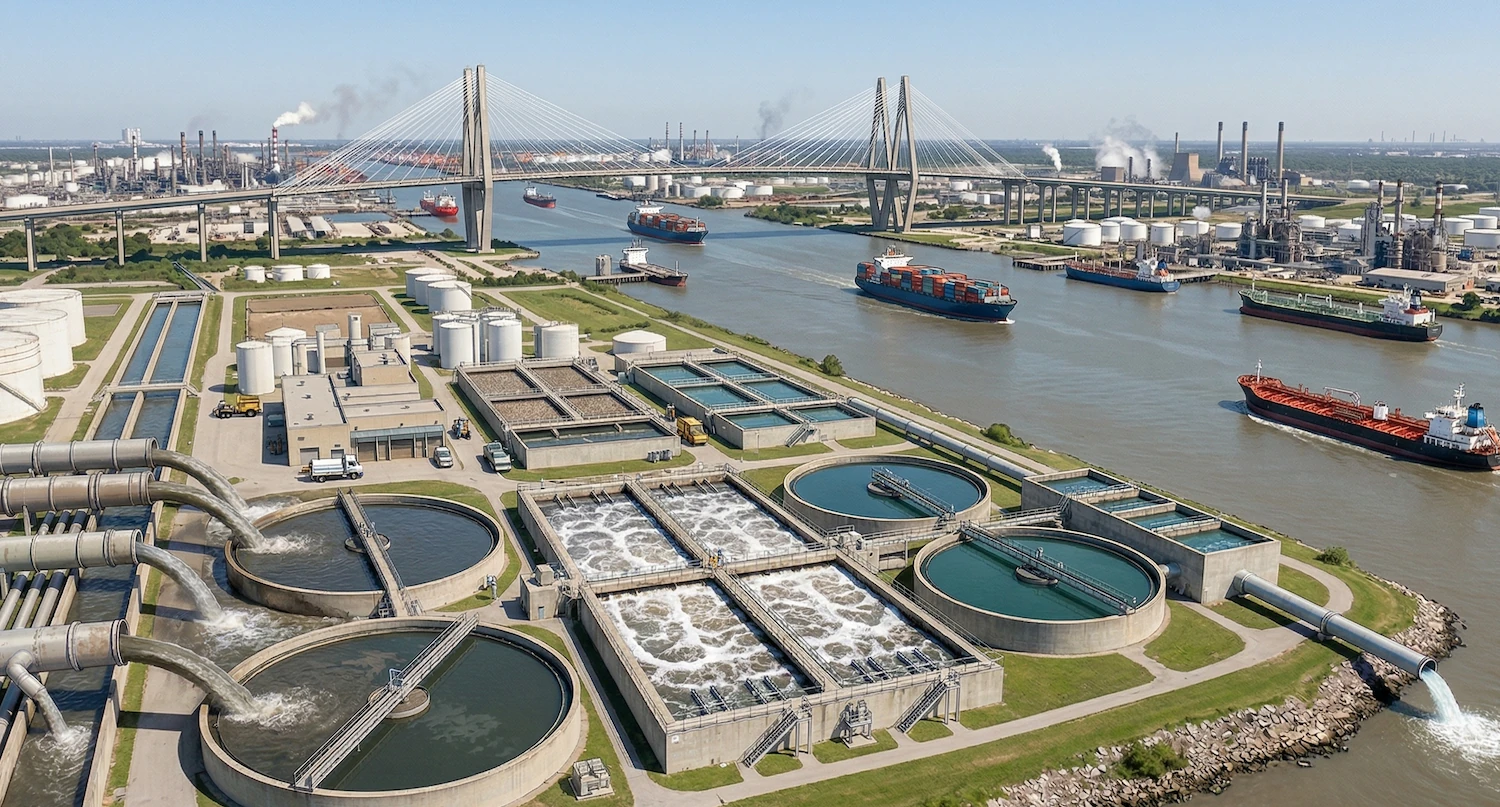
The Houston Ship Channel generates well over 100 million gallons per day of industrial wastewater from more than 200 facilities. New PFAS liability under CERCLA attaches to every handler in the chain. TCEQ overhauled its compliance history framework effective February 2026. And permitted treatment capacity along the corridor takes 12–24 months to obtain.
For terminal operators, refinery environmental teams, and industrial real estate investors evaluating Gulf Coast sites, wastewater treatment infrastructure has moved from cost center to competitive moat. This report provides the specific numbers — discharge volumes, contaminant profiles, treatment costs, permit timelines, and technology economics — that inform real decisions.
Six Houston-area refineries alone discharge approximately 55 MGD of process wastewater directly into the Ship Channel and surrounding waterways, according to the Environmental Integrity Project's 2023 analysis of EPA discharge monitoring data. ExxonMobil's Baytown Complex leads at 29.6 MGD, followed by Marathon Galveston Bay Refinery at 14.1 MGD and the Pemex (formerly Shell) Deer Park Refinery at 11.1 MGD. Texas's 19 refineries collectively discharge roughly 150 MGD.
These figures cover only direct refinery process wastewater. When you add petrochemical plant effluent, terminal operations, cooling tower blowdown, contaminated stormwater, tank bottom water, and volumes routed through third-party facilities like the Gulf Coast Authority's Washburn Tunnel and Bayport plants, the total industrial wastewater generation along the Ship Channel corridor is conservatively 100–150+ MGD.
The Texas Water Development Board's Ship Channel feasibility study estimated approximately 94–100 MGD of industrial water demand from the corridor, and the wastewater return flow from that consumption represents the bulk of what must be treated.
The wastewater streams are as varied as the operations generating them. Refineries produce desalter water high in chlorides and salts, sour water stripper bottoms carrying ammonia, sulfides, and phenols, and cooling tower blowdown laden with TDS and biocides. Terminals generate tank bottom water, oil-water separator waste, barge ballast water, and contaminated stormwater from tank farms and loading areas. Petrochemical plants add reactor washwater, catalyst regeneration water, and spent caustic streams.
ExxonMobil Baytown discharged 127 million pounds per year of TDS alone — the highest of any refinery in the country. Nationally, 83% of U.S. refineries violated their permit limits at least once between 2019 and 2021, but only about 25% faced penalties. The top violations were TSS (218 exceedances), sulfide (76), pH (64), ammonia (64), and BOD (59).
Texas administers its own discharge permitting program through the Texas Pollutant Discharge Elimination System (TPDES), delegated from EPA since 1998. TPDES permits must be at least as stringent as federal NPDES requirements, and for Ship Channel dischargers — where the channel is listed as impaired on Texas's 303(d) list — permits often impose water quality-based limits that exceed federal technology-based minimums.
New TPDES individual permits require applications submitted at least 330 days before a proposed discharge begins. In practice, the typical timeline from application submission to permit issuance runs 12–24 months for complex industrial facilities. Contested case hearings can push this well beyond two years. Renewal applications must be filed at least 180 days before expiration.
The direct cost structure includes application fees of several thousand dollars for individual permits ($100 for the TXG340000 petroleum bulk station/terminal general permit), annual Consolidated Water Quality fees ranging from $1,250 minimum to $144,775 maximum per year based on permitted flow and contamination factors, and inactive permit maintenance at $620 per year. Engineering and consulting costs for complex industrial applications typically run $50,000–$200,000+, with contested case hearings adding $100,000 or more in legal fees.
The most consequential regulatory change for Ship Channel operators is TCEQ's revised compliance history framework under 30 TAC Chapter 60, effective February 5, 2026. This rule implements a points-based repeat violator classification system that now includes minor and moderate violations — previously only major violations counted. Key changes include semiannual compliance history updates (replacing annual), separate counting of each unauthorized discharge event, and repeat violation points triggered by three or more violations of the same nature within a five-year period.
Facilities classified as "unsatisfactory" under the new system cannot qualify for general permits and must obtain individual permits — a dramatically more expensive and time-consuming process. SB 1397 also raised the maximum daily administrative penalty from $25,000 to $40,000 per day for egregious violations.
EPA's CERCLA hazardous substance designation for PFOA and PFOS took effect July 8, 2024, with a reportable quantity of just 1 pound in 24 hours. The Trump administration confirmed in September 2025 that it will retain this designation, and the D.C. Circuit heard oral arguments on industry challenges in January 2026.
This creates strict, joint and several, retroactive liability for current and former owners and operators, generators, and transporters of PFAS-contaminated waste. Any facility that handles PFAS-containing influent — and essentially every Ship Channel refinery and petrochemical plant generates some PFAS from firefighting foam, surfactants, or process chemistry — is potentially a responsible party under CERCLA.
EPA's enforcement discretion memo from April 2024 exempts POTWs and municipal systems but explicitly does not protect private industrial wastewater treatment facilities. Congressional efforts to provide statutory protection for passive receivers (the Water Systems PFAS Liability Protection Act) remain pending.
The drinking water MCLs of 4 ppt for PFOA and 4 ppt for PFOS — finalized April 2024 with the compliance deadline extended to 2031 — serve as de facto cleanup standards under CERCLA and create downstream pressure on all industrial dischargers. These concentrations are orders of magnitude below most industrial detection limits.
The Biden administration's proposed PFAS discharge limits for organic chemicals facilities were withdrawn January 21, 2025 under the regulatory freeze. However, EPA's September 2025 Unified Regulatory Agenda indicates a re-proposed OCPSF PFAS effluent guideline anticipated in January 2026, with metal finishing PFAS ELGs targeted for July 2026 and landfill leachate ELGs for 2027.
Texas's Multi-Sector General Permit (TXR050000) expires August 14, 2026, with the renewal process already underway. For petroleum terminals and refineries, the critical regulatory question is when stormwater becomes process wastewater.
Under 40 CFR Part 419, contaminated runoff commingled with process wastewater triggers the full process wastewater effluent limitations. Contaminated runoff exceeding 15 mg/L oil and grease or 110 mg/L TOC faces concentration-based limits even without commingling. This means petroleum terminals typically need dual permit coverage: TXG340000 for process wastewater and contact stormwater, plus TXR050000 for non-contact industrial stormwater from other facility areas.
Stormwater compliance costs include SWP3 preparation ($5,000–$25,000), quarterly sampling and analysis ($2,000–$10,000 per year per facility), BMP installation for oil-water separation and retention ($50,000–$500,000+), and stormwater treatment systems for contaminated runoff ($100,000–$1,000,000+ depending on flow and contaminants).
The petroleum refining effluent guidelines under 40 CFR Part 419 were last updated in 1985 and regulate only 10 pollutants. There are no federal limits on selenium, benzene, cyanide, mercury, PFAS, total nitrogen, or TDS in refinery wastewater. EPA completed a detailed study of the petroleum refining category in 2019 but took no rulemaking action.
Third-party treatment providers in Texas typically charge $5–$14 per barrel ($0.12–$0.33 per gallon) for industrial wastewater processing. Deep well injection costs significantly less at $0.60–$1.50 per barrel for commercial disposal, with owner-operated wells as low as $0.025–$2.00 per barrel. Trucking wastewater without pipeline access can reach $2.50 per barrel or more.
New wastewater treatment facility construction follows a general rule of approximately $12 million per MGD of average flow capacity. More granular estimates include $6.50–$7.50 per gallon of daily capacity for conventional secondary treatment and $8.50–$10.50 per gallon for advanced tertiary treatment including filtration and UV disinfection. A 5 MGD industrial system runs $6–$12 million; a 20 MGD MBR with advanced filtration reaches $40–$60 million or more.
Operating costs break down to roughly $0.76–$1.89 per thousand gallons depending on technology, with energy consuming 25–40% of total OPEX, personnel 20–35%, and chemicals 10–15%.
The cost of non-compliance provides the floor for treatment investment decisions. Federal Clean Water Act civil penalties run up to $56,540 per day per violation. Texas administrative penalties now reach $40,000 per day. RCRA hazardous waste violations can hit $70,117 per day. Oil spill penalties under the Clean Water Act are $1,100 per barrel standard or $4,300 per barrel for gross negligence.
The typical refinery or petrochemical treatment train on the Ship Channel follows a well-established progression: primary separation through API separators (removing free oil above 150 microns to roughly 50 mg/L), followed by dissolved air flotation units achieving 85–95% TSS removal and up to 96% FOG removal, then biological treatment for dissolved organics, BOD, COD, and phenols. Tertiary polishing with granular activated carbon addresses residual organics and VOCs, while ion exchange handles heavy metals and increasingly PFAS.
DAF systems represent a sweet spot of cost-effectiveness for Ship Channel operators: equipment runs $120,000–$300,000 for mid-range capacities, with operating costs driven primarily by chemical coagulant dosing at roughly $55,000–$66,000 per year for a 660 GPM system.
Membrane bioreactors offer superior effluent quality in a smaller footprint — critical for space-constrained Ship Channel sites where land runs $10+ per square foot — but capital costs run $2.9–$6.9 million per MLD (0.264 MGD).
The PFAS treatment challenge is driving significant cost escalation. Granular activated carbon achieves 92–100% PFAS removal when fresh, but performance degrades with aging. Treatment costs for PFAS via GAC run $900–$1,400 per million gallons on a 30-year amortized basis. Carbon prices have risen approximately 16% year-over-year to $2,150–$2,470 per metric ton in late 2025, driven by tightening supply against PFAS-driven demand. Ion exchange outperforms GAC for short-chain PFAS but generates brine requiring disposal at $0.20 per gallon.
Houston Ship Channel industries consume approximately 94–100 MGD of water, split roughly 46% for cooling, 43% for boiler feedwater, and 11% for other process uses. The broader Region H (15-county Houston metro) manufacturing sector demands approximately 594,000 acre-feet per year, projected to grow 17% to 695,000 acre-feet per year by 2030.
Water costs have escalated sharply. City of Houston commercial and industrial rates have climbed from $5.55 per 1,000 gallons in FY2022 to approximately $8.24 per 1,000 gallons by FY2026 — nearly 50% in four years. The San Jacinto River Authority charges $0.66 per 1,000 gallons for raw water and $3.10 per 1,000 gallons for treated surface water.
Region H water demand is projected to exceed supply by 883,000 acre-feet per year by 2070, even as existing supply declines 5% from groundwater reduction mandates. The Harris-Galveston Subsidence District, created after Ship Channel-area land sank up to 10 feet by 1979, continues to mandate surface water conversion. Current reuse rates are just 3% of regional water supply — the lowest among major Texas metros — but TWDB studies show that reclaimed water for boiler feedwater can be produced at $1.74 per 1,000 gallons versus $2.34 for treated raw water, a 26% savings.
Ameritank's La Porte facility sits on 4 billion gallons of annual water access — a legacy infrastructure advantage that eliminates the water supply bottleneck for prospective terminal operators and tenants.
The Gulf Coast Authority (GCA) dominates third-party industrial wastewater treatment on the Ship Channel. Created by the Texas Legislature in 1969, GCA operates four regional facilities serving 90+ industrial customers under a unique exemption from federal categorical pretreatment standards. The Bayport Industrial WWTP processes 24 MGD average flow for 70+ petrochemical customers. The Washburn Tunnel WWTP, located directly on the Ship Channel, serves 17 customers including the LyondellBasell Houston Refinery, Chevron Pasadena Refinery, and Kinder Morgan Galena Park Terminal.
Texas Industrial Water Management (TIWM) in Channelview operates a TPDES-permitted facility capable of receiving up to 30,000-barrel barge shipments for treatment, running 24/7 with biological treatment, tertiary filtration, and disinfection.
Clean Harbors operates the largest incineration capacity in the United States at its Deer Park facility, plus multiple La Porte locations handling hazardous waste. Republic Services, which acquired US Ecology in 2022 for $2.2 billion and Shamrock Environmental in February 2025, is expanding its environmental solutions footprint across the Houston metro.
The major refineries with on-site treatment discharging directly to the Ship Channel include ExxonMobil Baytown (29.6 MGD, 584,000 bpd crude capacity), Marathon Galveston Bay (14.1 MGD, approximately 593,000 bpd), Pemex Deer Park (11.1 MGD, approximately 340,000 bpd), and Valero Houston Manchester (approximately 205,000 bpd).
The global industrial wastewater treatment market reached approximately $18–20 billion in 2024–2025, growing at 5.5–6.5% CAGR toward $30–34 billion by 2034, with oil and gas the largest end-use segment at 9.3% CAGR. On the Gulf Coast specifically, 114 proposed oil and gas projects at 89 Texas locations are driving demand for treatment capacity that takes years to permit and build.
M&A activity confirms the value thesis. Environmental services deal volume rose 28.1% year-over-year to 89 transactions through mid-2025, with water and wastewater treatment deals up 41.7% to 34 transactions. EV/EBITDA multiples for water utilities averaged 14.3x in 2025. Republic Services' acquisition of Shamrock Environmental specifically targeted its permitted CWT capacity as the primary value driver.
Houston's industrial real estate market reflects this dynamic. Overall industrial vacancy stands at 6.0–7.4%, but manufacturing vacancy is just 2.2%. Average industrial rents hit an all-time high of $10.67 per square foot NNN in Q4 2025, the seventh consecutive quarterly record. The Site Selectors Guild identified wastewater capacity as a common bottleneck in site location decisions.
For terminal operators evaluating tenant attraction, a pre-permitted site with pipeline-connected wastewater treatment avoids 12–24+ months of TPDES permitting timeline, eliminates $50,000–$200,000+ in application costs, and removes the risk of unsatisfactory compliance history disqualifying a facility from general permit coverage.
The convergence of PFAS liability, tightening TCEQ compliance rules, water scarcity, and explosive petrochemical growth is creating a structural premium for industrial sites with permitted wastewater treatment capability along the Houston Ship Channel. The numbers tell the story: 100+ MGD of industrial wastewater from a corridor where treatment capacity is constrained, permit timelines run 12–24 months, CERCLA PFAS liability attaches to every handler in the chain, and water costs have risen 50% in four years.
Operators who invested in treatment infrastructure ahead of these shifts hold permitted capacity that cannot be quickly replicated — and the M&A market is valuing that capacity at multiples not seen in five years. For terminal operators, refinery managers, and industrial investors on the Gulf Coast, wastewater treatment has moved from cost center to competitive moat.
Ameritank's 147-acre La Porte facility offers existing water and wastewater infrastructure with 4 billion gallons of annual water access, Union Pacific rail, deepwater barge dock, and direct Houston Ship Channel frontage — eliminating the permitting, construction, and timeline barriers that constrain competing sites. Learn more about Ameritank's terminal capabilities.

Andrew Viera
Business Development Executive, Ameritank
Andrew manages offtaker relationships, capital partnerships, and strategic positioning for Ameritank's 147-acre terminal on the Houston Ship Channel. He works across terminal development, investor relations, and market analysis to connect infrastructure capacity with commodity demand across the Gulf Coast energy corridor.